Chapter 2: “My Silver Bowl”

Some days this is my favorite chapter (story). I am fond of all the characters, but Mary Said especially. She is the housekeeper for Meredith after David has died and it’s just the mom, the three girls, and their grandmother. Mary works at the university as a housekeeper and picks up additional work, at this time, with the Collins family. She is also an animal lover, especially dogs.

Mary makes the mistake of plagiarizing, something I was quite strict about when I taught, reporting students on up the line. I’d let them redo the assignment or in some other way continue forward, saying “I won’t hold this against you,” believing that everyone deserves a second chance. When Mary is discovered she descends into a depression, which she describes this way: “because that’s what I feel like I’m in, the darkest, loneliest cave you can imagine, and what’s worse is I’m in the cave that’s in me.” She says that it was probably for two years that she refused to look at herself in the mirror.

This is a story about envy and love and healing. Mary believes herself unattractive and is sure that her long one-course-at-a-time education is a fraud. Her self-loathing is nothing new to me. I’ve struggled with it and I’ve watched friends and family agonize over their worth—especially when they make a mistake. Just last night I was watching an episode of The Long Shadow, and a taxi driver played superbly by Terry Hackshaw, says tearfully when he is questioned, “I don’t like meself. I don’t know meself.” He wishes he could confess just to have the agony of the detective’s scrutiny over. Beautiful, brilliant, wounded Virginia Woolf felt it her entire life. Almost anyone who has been abused has had to work at overcoming it. A Salon article by Michele Filgate examines self-loathing as it relates to writers regarding their own work. Are women and men different in feeling that it’s okay to call themselves writers? Are they worth it or are they faking it? She cites Jonathan Franzen and Elizabeth Gilbert in particular. I love Gilbert’s response. It’s worth a look, here.

Mary is hard on herself, feels herself unworthy. Yet she knows it’s envy that’s making her hurt, and she knows that loving others who are not as strong as she is—that would be the dogs she has rescued—is what she does best. I like what Meredith tells her near the end of the chapter, and I like that the three daughters make her feel welcome. You can tell yourself all you want how worthy of love you are, but it sure feels good when the people you value let you know that it’s so.

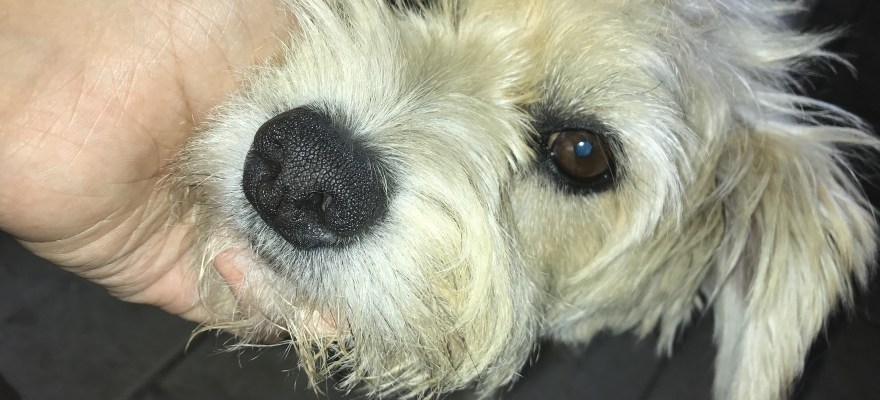
I don’t have a photo of Mary’s teacup poodle, Big’nuff, so I’m sharing this of our little guy, Beah.

To order Letters of the Karst, request it from your local library or order from amazon, here.

“Snowflakes in the Blizzard” One of 3 featured poets

I’m so pleased to have learned of Snowflakes in a Blizzard (Separating authors from the herd and giving them one-on-one time with readers), a blog hosted by Darrell Laurant, who contacted me a couple of months ago. I’m grateful for the kind surprises in life. Here’s the site. And here’s what Darrell says (excerpt):

I hope you enjoy it. And if you’d like to be included, contact me at writersbridge AT hotmail.com.

Best,

Darrell Laurant

Note: I am a 40-year veteran of journalism who retired two years to do freelancing full time. My first novel, “The Kudzu Kid,” was published last October, and lots of people are not buying it. A more recent book, “Inspiration Street,” is doing considerably better. Maybe I’m learning something.

When “the holidays” come

I had occasion the other day when someone said, “the holidays are usually the hardest,” to respond, “For most people, yes, but it doesn’t bother me.” I have reflected on my glibness and wondered if that’s why, ever since, he has placed himself so center, as if to say, “Really? You’re not troubled just a little?” Here we all are (most of us), preparing to gather with family and friends, to celebrate according to our traditions. It’s a time when we try to include everyone. Sometimes we run ourselves ragged, catching a few hours with this family member, fighting traffic and avoiding holiday accidents (drunk revelers), just so we can give a hug and laugh a little.

And that’s good. Laughter is. But then we notice a tinny quality in our own voice and that’s when the missing person’s absence pushes us against the wall, even years later. We’ve had no choice but to accommodate, but we’re not “over it” and the trite “closure” they keep talking about is more to satisfy a narrative than to describe reality. The wound doesn’t close, though we may go months with the seeping so subtle we don’t notice until all of the sudden the pool is full and flooding behind our eyes.

That is one way we fool ourselves, the glib wave of the hand–but it should be a warning, anytime our answer comes so fast and easy: get ready for big dose of humbling.

More reflective now, I am missing being able to see and touch two sons. In the next 10 days, I will love (and touch and laugh with) my oldest and our two granddaughters and my family. But I will honor the sadness that comes when we’re supposed to gather all the ones we love into our wide embrace and can’t. I will stop saying, it doesn’t bother me.

So this poem is for that. It’s a modified ghazal, “Ghazal by a Thread.” If you’re listening, given them a hug.

Minor Chord

I wrote this poem to mark the way we continue to see a beloved who has died–in other people, in the way someone walks or the shape of a jaw. It’s been seven years and I still turn back, just to be sure, when someone has caught my eye for some little thing that reminds me of him. In that moment the possibility of him rushes back. In “Minor Chord,” I wanted to start with the idea of “if” (if only) to try to express the longing that comes whenever we see someone who shares that little piece of him–that gesture–and how this merging of stranger with beloved is like the merging of song and painting.

Inspired by my students (“when I fall”)

Recently, my students in SRSC 525 Place and the Problem of Healing, submitted their self-portraits, designed as woodcuts using black and white paper, most of them. They then photographed their design and shared it using Voice Thread (my class is online, so this gave us the opportunity to step off the page for awhile and listen to others’ narratives). They were all so wonderful I wish I could share them here. Two of them featured trees and roots as part of the design, and they reminded me of my own “tree forms” poems, so I told them I wanted to share one of them, the one recorded below, “When I Fall.” I haven’t read or thought of this poem for awhile, so it pleased me that other elements of my students’ self-portraits came up–stars, for instance, and mountains, and stepping stones, or in this case a path that was once the tree.

Since I haven’t posted on my blog for awhile (which makes it seem as if I don’t care about poetry anymore). . . . sad face . . . I am back, if briefly, with this:

Trees, Ram Dass, and “The Story They Tell”

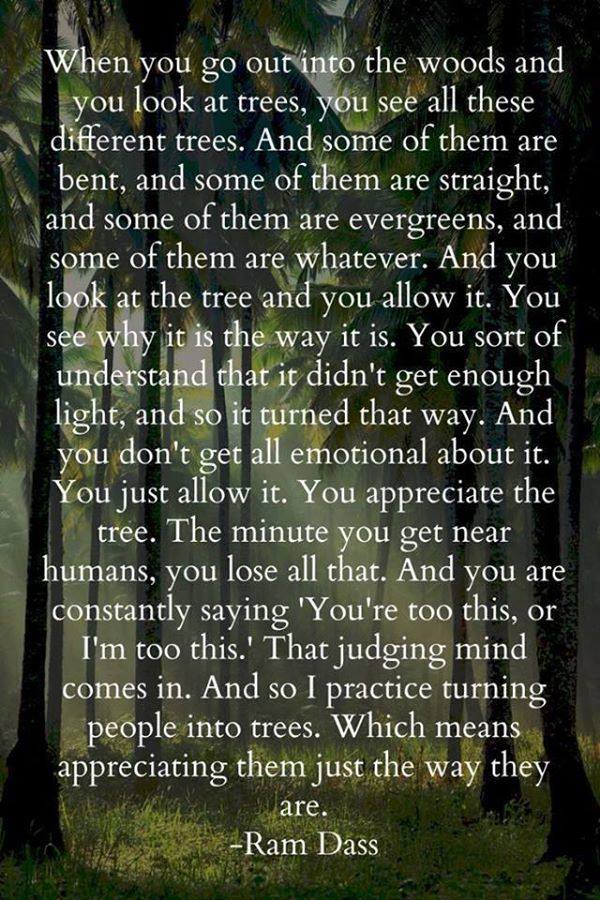
Browsing Fb this morning, I saw the following meme posted by my friend Betsy. I thought, “Yes!” and then “Tree Forms”! And then decided to share this poem, in praise of the story trees tell, and in appreciation for Ram Dass’s good decision to see everyone as a tree…..Here’s the meme, then the reading. Thanks!
RamDassQuoteHere’s the reading of “The Story They Tell Is Our Story.” I appreciate the excuse to read it and at the same time to share this so-true quotation of Ram Dass.

Bird Colonies in My Attic

Last week, we covered a gable vent with wire mesh, our attempt to keep another family of birds from nesting in our attic crawl space. This is at the front of the house. I see from the upstairs bathroom window at the back of the house that another avian family has put down roots in the eaves, where an opening between two pieces of siding offers up a kind of private doorway. Bits of twig poke through and when the parents arrive with a flutter of braking tail feathers, the otherwise timid scrabbling sound goes wild. Within a week, the sweet little peeps are hearty shouts. “You’re back! Finally! Me first! Where’s mine?!”

So, it seems like a good occasion to share a reading of one of the poems in Seeking, called “Someone Else’s Offspring.” I hope you enjoy it.

It’s spring and you’re here

Welcome to my blog. I’m focusing for now on my upcoming collection of poetry, Seeking the Other Side. I hope you are a lover of good poetry, and that you might find an interest in mine! I’ve got a tab for Poetry, where you can read reviews for the collection and for my chapbook, Tree Forms. I may slide an occasional poem for you to listen to, if you have time.

Here’s “A Whisper for You.”

~~~~