Cover for Letters from the Karst

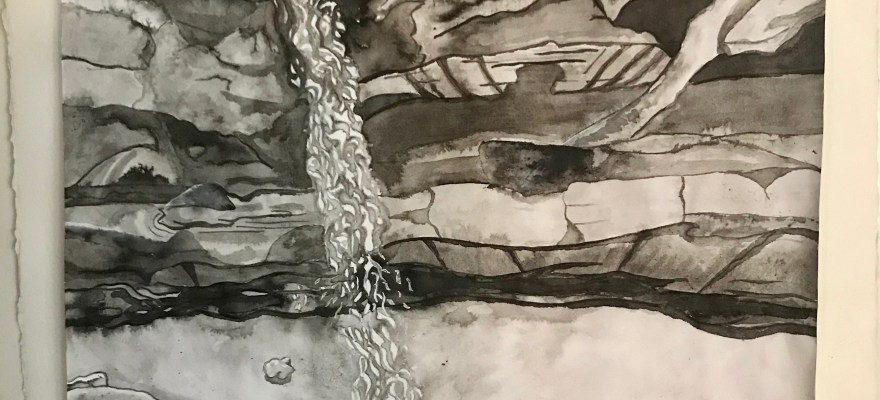
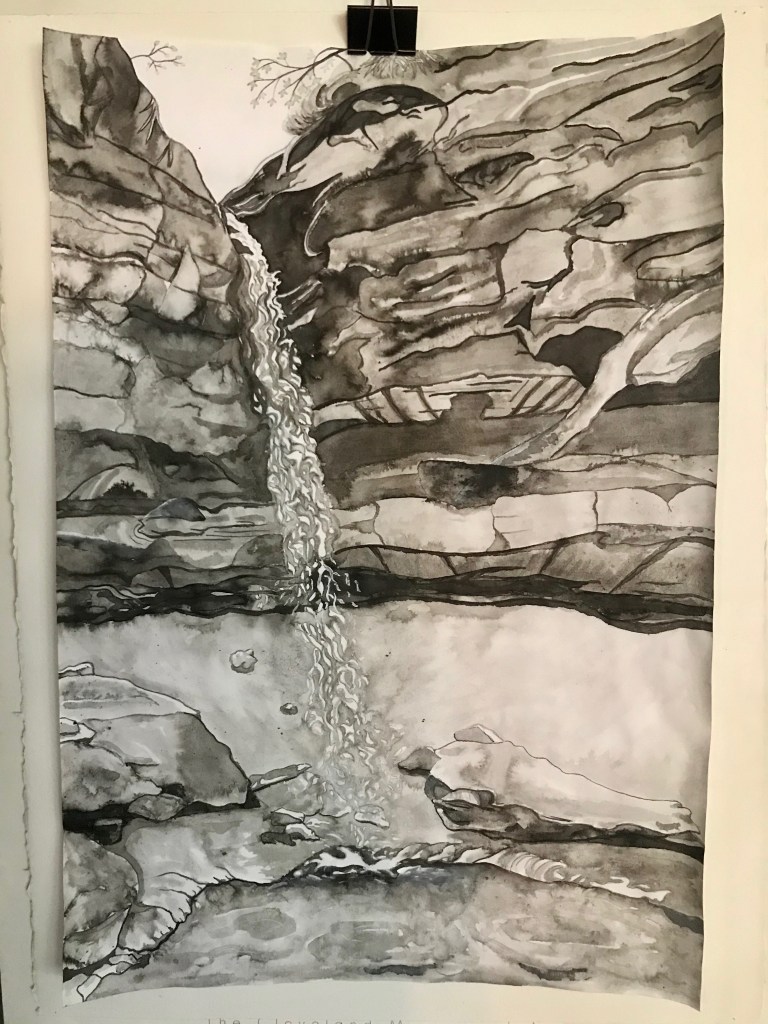
I’ve had the good fortune to publish three books, and each time was able to use an image for the cover created by a local artist’s work (I’ll get back to this). With Letters from the Karst, Teresa Christmas, though she was in the middle of her fall art classes, agreed. Her drawing of Shanty Hollow, the local woodsy trail that ends at a waterfall, beautifully captures karst country. Here it is:
What I didn’t know is that Teresa has a direct connection to Floyd Collins, the famous caver and fortune hunter who was trapped in Sand Cave up the road a few miles from Bowling Green. The spectacle that resulted with attempts to rescue him captured the attention of the entire country. This is described brilliantly in Robert K. Murray and Roger W. Brucker’s Trapped: The Story of the Struggle to Rescue Floyd Collins from a Kentucky Cave in 1925. It’s a page-turner. Everything for a first-rate melodrama came together in Floyd’s story: bravery, tragedy, massive media coverage, schemers, betrayers, technology, Kentucky culture and history, and medical rescue (failure).

I had to make a connection to Floyd’s story in a novel about the karst system, right? . . . hence the fictional birth of the Collins family, related somewhat distantly to Floyd, through the current-day grandmother’s father, who was Floyd’s cousin.

So I was pleasantly surprised when Teresa told me what she discloses in her artist’s statement:

I am a Kentuckian. My ancestors, for five generations, or more, have lived their lives  in the remote hollows and the rocky slopes of south central Kentucky where they are buried in graveyards and homesteads lost to memory. Floyd Collins is my grandmother’s first cousin. 

This is almost exactly the lineage I invented. Meant to be?

Also in her artist’s statement she talks about her choices for the drawing, beautifully seeing exactly what I was trying to do in the writing:

My choices for content, media and design were—I realized almost after the fact—inspired by the complicated and nuanced emotional responses Jane managed to evoke in me as I navigated her web of interconnected tales—not a roller coaster ride, exactly, but a winding trail, for sure—one that leads through bright sunshine and dark shadow.

Black ink wash seemed the perfect way to explore those gradations of light and dark, and I have always been drawn to traditional Asian black ink art, in part because it can capture flowing water in ways that other media cannot.

I admire what artists can covey, taking what’s inside and transcribing it for others to see. My son has this ability, and I was very happy that he agreed to do the cover for my second book, a memoir, The Tree You Come Home To:

He was sensitive in his choice of colors and blurriness (my word for it), due to the content, which tells the story of his youngest brother, who was killed in 2009, and my own approximately four-year journey to healing. There’s a sense of light coming through, sunrise maybe, and the purple evokes the emotional depths that we had to travel. I love the fence emerging on the left and disappearing into the mists behind the tree.

And that brings me to the artist I prevailed upon for my first book, Yvonne Petkus, professor of art at WKU. Her painting, Braced, is wonderful for Seeking the Other Side, my collection of poems. Doesn’t this woman evoke the embodied yet coming apart aspect of seeking the deeper meanings of life? Or, is she coming back together after being partly dis-embodied? Or, is this what happens over and over again in life as we journey away from and (hopefully) return to our full selves?

In an exhibition catalog, Searching, another local artist and WKU professor, Kristina Arnold, describes Petkus’s work, noting how it “unashamedly confronts the physical and psychological effects of violence and the collective residue accrued both individually and as a society through repeated trauma.” Yvonne described to me the repeated imagery of the woman coming into and going out of a visible sphere as evoking a process, about the becoming of self as many acts of courage or questing. Perfect.

Chapter 11: Extremophiles

The final chapter, bookend to the opening one, “Letters from the Karst,” is the mother Meredith’s story. I think everyone comes together here, whether from the past when the girls were young or in Meredith’s journals about loss or in the current day, when all three horses make their reappearance. And Meredith is a caver, her cave needed to be big. I could have picked Mammoth Cave, but I needed something unfamiliar for Meredith to explore. That’s why I picked Lechuguilla at Carlsbad Caverns.

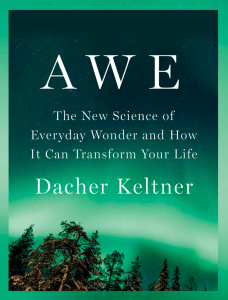
Since I am reading Dachner Keltner’s Awe: The New Science of Everyday Wonder at the same time I’m re-thinking Letters from the Karst, it’s probably no surprise that Meredith’s trip to Lechuguilla came to mind. I first learned of Keltner’s book when listening to Krista Tippett’s On Being, where she interviews him about his latest book. (If you don’t know On Being, it is the best podcast out there!) Here’s a link to her interview with Keltner, “The Thrilling New Science of Awe.”

Keltner writes,

Vastness can be challenging, unsettling, destabilizing. In evoking awe, it reveals that our current knowledge is not up to the task of making sense of what we have encountered. And so, in awe, we go in search of new forms of understanding.

This is precisely what happens to Meredith on her caving expedition. Due to a minor rockslide she is left dangling for longer than is comfortable. Although experienced and perhaps due to her being on the cusp of a change in her life preoccupations, no longer writing about the loss of her husband David and instead reflecting on place, Meredith is ready for an epiphany.

This cave was a great ear, and I could feel it pressing itself against my skin. I was terrified of plummeting hundreds of feet with a thin rope and a hand brake all that kept me from a fall that could be as easily up as down, so suspended space had become.In perfect darkness I waited, suspended in the great throat of the cave. My line turned me slowly and now I heard it. A breath, a low sigh, a loneliness so deep that it had lost the awareness of self that loneliness usually heightens. I reached my hand out and the sigh rose. My lips opened, and the sigh shot up from the depths.

Later, she realizes:

I had gone to see a different cave formation than the ones I grew up with in Kentucky. I wanted to step outside of what had become home. I have been there three times now and co-written two papers trying to help untangle the mysteries that fascinate us. It happened in the midst of writing that second paper, the sudden certainty that I was telling only half the story—the surface of life beneath the surface—and so I began writing travel pieces for non-academic magazines, essays about life in all its extremities.

Although I didn’t realize it at the time, what I was describing for Meredith is the experience of awe, which according to Keltner, “is the feeling of being in the presence of something vast that transcends your current understanding of the world” (7). Maybe “epiphany” should be the subtitle for Letters from the Karst. The characters all wake up from some depth of slumber, so their epiphanies may be mild, more like a twitch, or signficant, marking a radical new path. Perhaps this is also what happens when we experience “wonder.”

Public domain

Today’s post is quite a “quote-y” post, but I love the serendipity when what we’re reading, writing, or thinking about come together, and Keltner and Meredith belong together (with me).

You can order a copy of Letters from the Karst from your local bookstore or at Amazon, here.

Chapter 10: On the Beautiful O-hi-o

Each chapter (or story) in Letters from the Karst features a different kind of cave or big hole in the ground. Like a karst system in which some caves are intimately connected and others less so, the characters may have close ties or be more removed, as is the case with Pat Likens in “On the Beautiful O-hi-o.” That phrase was rattling around in my mind at the time of writing this story, and since I grew up in Ohio, I like it that the setting, though in Kentucky, is partly on the banks of the Ohio—there I am marked and shaped by both Ohio and Kentucky.

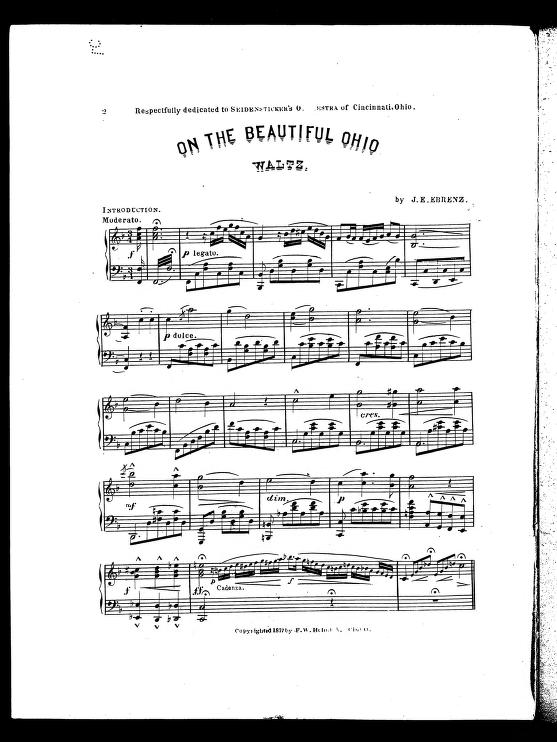
Here is an image of the sheet music for the waltz of the same name, in public domain. (My mom would approve of my including an image of written music.)

Pat is a colleague of Meredith at WKU, teaching in the English department. The first word is “Married,” and Pat is not happily so. The full sentence reads, “Married, Pat Likens lay in bed after her husband fell asleep, imagining his death.” It’s not an abusive relationship but Carl is possessive, and Pat is ready to move on. More than any other chapter, “Oh the Beautiful O-hi-o” weaves Pat’s dreams into the narrative that ends at a party of a colleague who has a big house on the Ohio River.

In an allusion to Virginia Woolf’s metaphor in A Room of One’s Own, the opening dream is of her fishing “where consciousness floated on top like an anchored dock at the edge of a country pond.” The dream intensifies:

Her shoulders strained and her feet slid in the muddy grass toward the pond. The pole bent dangerously, and suddenly the line angled beneath the bank, as though she were on a boat and the fish about to surface behind her. She even turned, and yes there were the trees, her car parked at the top of the small hill, the lawn chair with her book unopened in the grass beside it. She turned back and caught her first glimpse of something below the surface, and then her pole snapped. A moment later a man’s arm grabbed hold of a root just inches from her foot and began to pull a body tangled in fish line out of the water.

Pat’s dreams are violent, but there is no violence in waking time. All rage and disappointment have been sublimated and appear in dreams. The cave in this story appears in the final dream as a place that’s eerie and suggestive of danger. But everything happens outside the cave:

Ahead she saw the darkened entrance to the cave and behind her she felt the dogs’ breath on her heels. Time paused as she slid into a weird space and an ethereal sound arose from the depth of the cave before her; she stretched her arms toward it and with a snap, her dream picked up where it had left.

Dreams are important cave-like phenomena, emerging from the deep and bringing the darkness to the surface. But darkness is not necessarily bad, despite our fear of it; in fact, it’s essential to the processes that allow us to change our world.

You can order Letters from the Karst from your local library or from Amazon, here.

Chapter 9: Movie Lines

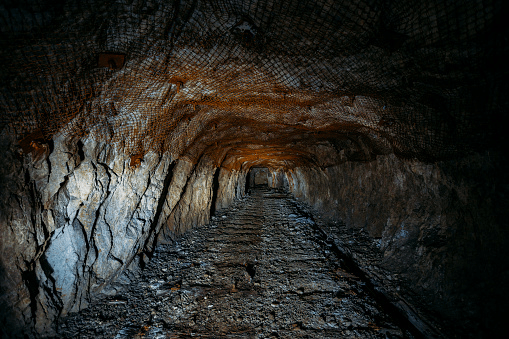
I was inspired to locate this “cave” in a retired mine, which I imagine to be like Portal 31 in in Lynch, Kentucky, where we’ve visited the area several times. Here I am outside Mine No. 31, and an image of an old mine (public domain), which is similar to what I had in mind. (Sara Jackson, former wonderful student, reminded me that she took the picture—thanks, Sara!—on a residency trip for our no-longer-in-existence master’s degree in Social Responsibility & Sustainable Communities.)

There’s the Benham Schoolhouse Inn there, the Kentucky Coal Museum with its Loretta Lynn floor, and nearby in Whitesburg, the wonderful Appalshop, which produces superb video documentaries on the area, for instance Sludge, Belinda, Stranger with a Camera, and Fast Food Women, all of which I’ve used in classes. Here’s their website.

Diana, the oldest of the three sisters in Letters from the Karst, is in eastern Kentucky as part of her work with Appalshop. Her contact, Edna, takes her son Tyler and Diana to the old mine, where a ceiling collapses behind them. But this is really Tyler’s story. Traumatized by his drug addicted father, he talks only in movie lines. He’s got a large repertoire and things he can say, in part to watching lots of movies and in part because he has a great memory.

The collapse occurs in the opening sentences. Then, Diana says,

“The danger’s over, don’t you think? Oh, shit. Ouch. Watch it, there’s something sticking up. Can you shine that over here?”

“It’s just a support beam. Look ahead, there’s a bunch of them. Can you see?”

“I see dead people,” Tyler said, watching as his mom played the light over a pile of what looked like bodies. They were stiff from almost a century lying there, and the miners had ignored them and eventually they got covered with old containers, empty lunch bags, dead batteries.

They continue their search for another way out, talking and sharing bits about themselves. The narrative alternates between the mine and Tyler’s memory of his father, an extremely abusive addict who betrays his son and shows no remorse. Tyler remembers how he’d talked back to his father:

Some dare-a-lick from Texas with big cowboy boots caught Tyler by the arm as he was walking past and pulled him between his legs. “I’ll give you $5,000 for this.”

“He’s worth twice that.”

In the truck Tyler had said, “You spent more’n that on this piece of shit, and it don’t even do your dirty work for you.”

Smack. “If that’s all the respect you got to show your father you can walk home and think about all I done for you.”

A few cars passed. After the first one slowed down, he started hiding in the weeds whenever he heard the whine of tires. He didn’t want to run into that Texan out here. Crouched there he watched a car full of partiers go off the road then get back on. A weak moon shed enough light to lay a ribbon through the trees where the road was. Coyotes on all sides yipped and howled. An owl cut a shadow across the sky. Crawling things rustled the leaves around him and from far away a dog’s bark became a yelp and then silence. He could live with the animals, he thought, someplace like where his dad’s strange uncle lived deep in the holler. Uncle Newby was crazy and everyone made fun of his hillbilly ways. Pipe. Piss can. Fishing pole. Green and blue bottles hanging from the trees. His mom used to say how living up there was just fine till someone broke a leg or got their foot caught in a trap.

So what. Accidents happen all the time, beginning with how you happen to get this mother and father. No one planned that. Not even God knew. So what if everyone went to church and said one thing and went home and did another. It wasn’t good or bad.

I enjoyed writing this though it wasn’t easy. I didn’t want to stereotype anyone, yet wanted to show how a caring mother and a wounded child negotiate through the very real problem of drug addiction. Tyler is a rather brilliant child, and his coping by speaking in movie lines seems unique and brave. Since Diana is there because she wants to help, I thought it important for Edna to challenge her on having a “rescue” mentality.

“So, how’d you end up on this project, here in eastern Kentucky?”

“It’s my last summer with Appalshop. I’ve been working with them for the last three years, doing interviews for films about the region. It’s what I want to do once I pass the bar—not interviews, but work in eastern Kentucky.”

“Why? You gonna come here and save the ignorant hillbillies?”

“I don’t see it that way.”

“We get alotta that, you know, do-gooders and liberals coming in here to basically do alotta looking and talking before they move on. But not before they take a bunch of pictures.”

“But I’m a Kentuckian, too, and I love the mountains. I love the people that I’ve met since I started working here. There’s no denying the problems. I’d think you all would welcome any help you can get.”

“Some help don’t end up helping.”

“As a lawyer, I think I could help.”

“What is it they say about lawyers—? Ninety-eight percent give the rest a bad name?”

Again, as I keep saying, I hope I’ve done them justice, Tyler and Edna, Diana, too.

You can order Letters from the Karst from your local bookstore, or through Amazon, here.

Chapter 8: Lost River

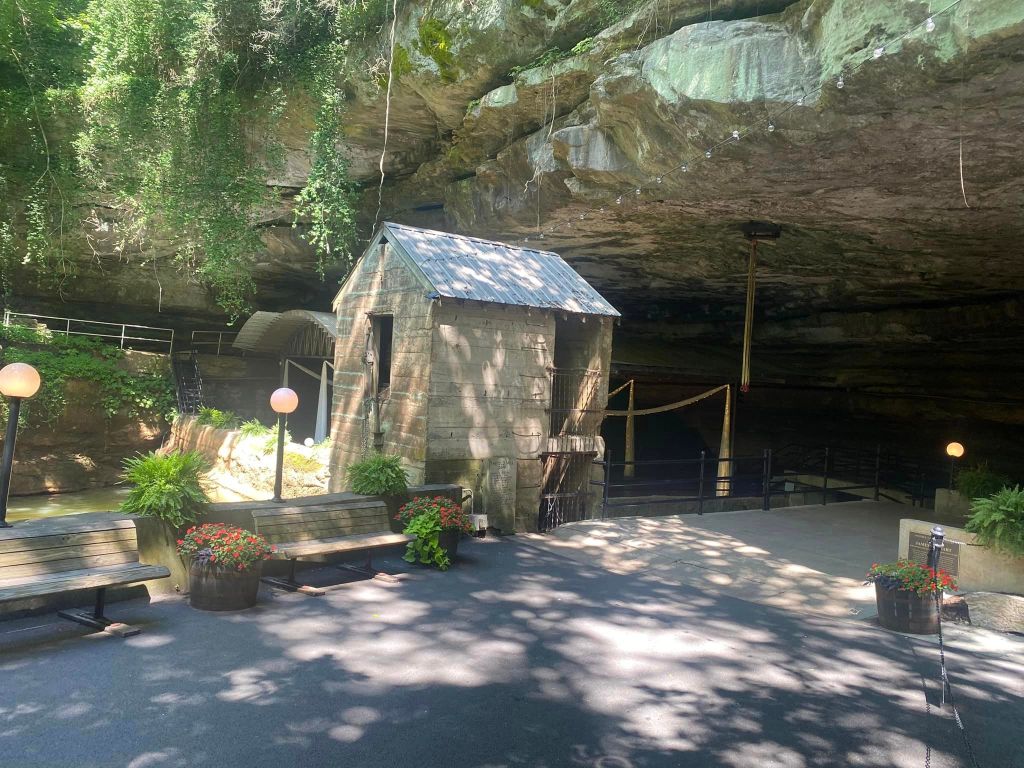
Bowling Green’s cave is a fascinating one, featuring a huge room large enough to hold several hundred people and an underground waterway that runs some 7 miles (only part of it accessible for tours). Once used as a dump site, in its more exciting days it was a night club and in an earlier century a Civil War camp. Its first inhabitants would have enjoyed it as a shelter and source of water. Maybe they camped there during the hot summer months.

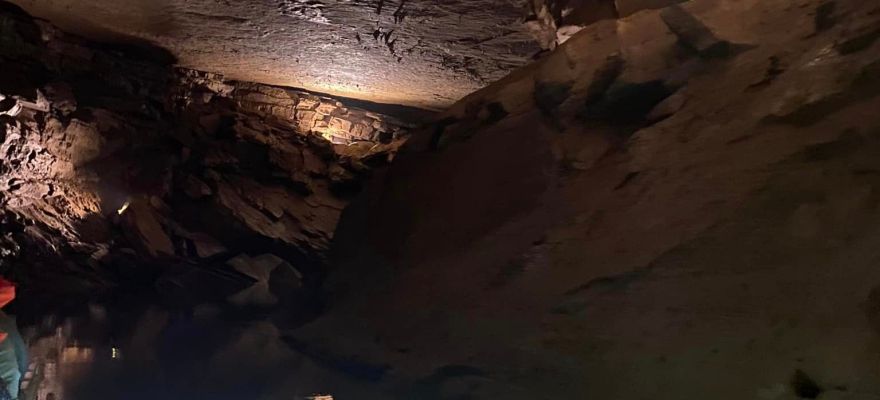
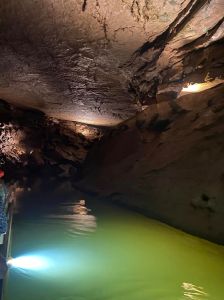
In “Lost River,” Derek, Cecily’s ex, is trying to put his life back together, though he still pines for Cecily. Its through his eyes that we learn of the explosion of a meth lab that likely scared them both straight. He is scarred, literally, from bits of glass hitting his face. Now, in current time, he has finished his education degree and teaches 3rd grade. On this day, he has taken his students on a field trip to Lost Cave. (The image, below is shared with permission of Maura Gerard, thanks so much!)

When they arrive, they pause on the path to the cave, which

led them past a blue hole, Ripley’s shortest river, running only 400 feet to the cave entrance. Once believed to be over 400 feet deep, the pool was actually only ten feet deep, linked with the underground river, where a current once deposited things miles away.

The guide’s voice got low and he looked around, as if he didn’t want anyone else to hear. “In a similar incident three soldiers went swimming, one didn’t come back, and his two friends, one by one, dove in to see what they could grab hold of. They were never seen again.”

Forty round eyes met his.

“Is that how come they call it the Lost River, ‘cause of people getting lost?”

The guide turned a page in his mental notes. “Late in the 18th century, some people found sawdust that was dumped into the water here in a pond about three miles away. That’s when they realized there had to be an underground river connecting the ponds all along.”

Lucy peered over the railing, into the greenish blue water.

“It don’t look anything special,” she said. “Looks like my grandma’s pond.”

“I don’t care what it looks like. You wouldn’t see me dive in after they didn’t come up!”

This was met with a chorus of “Me neither” and “That’s straight” and “I would . . . for a million dollars.”

Inside the cave, once settled on their boat, Derek has a panic attack but manages to keep it together. Below you can see that the ceiling is well above your head; however, at other points, you have to duck.

                                                     Photo by Maura Gerard, with her permission

Derek is a kind man, tolerant and patient. The story takes place on a single day, a strange one, including a traffic accident involving Lucy, a trip to the hospital where he sits with Lucy’s mother, Mrs. Jackson, and where he sees and talks briefly with Cecily. It’s a story of coincidences, the kind you might describe as “stranger than fiction.” But that’s how life works, in my experience, and especially when we’re paying attention, not lost in our thoughts, rehashing mistakes, planning that lottery win, worrying over bills or why no one takes us seriously.

You can purchase Letters from the Karst at your local bookstore or on amazon, here.

Chapter 7: “Who Do You Love?”

David, a poet, has a bi-polar condition that runs manic with intense crashes. This is what happens in chapter 7. What he’d thought was a brilliant student engagement project worthy of an award now seems puffed up and narcissistic. Each perception, though opposite, seems realistic in its time, and now that he sees himself as a pompous fool, the evidence stacks up everywhere he turns.

The project, a re-enactment of Plato’s Allegory of the Cave, gave me the opportunity to introduce a few things: a philosophical cave, probably the most famous metaphorical cave, the Doors (“Who Do You Love?”), and mental illness. Plato’s cave, with its shadows that people are unable to see beyond, is the perfect cave for David. The re-enactment he comes up with is rather clever, showing his creativity and gift as a teacher. He is also intelligent and able to see shadows and projections and “what’s real.”

Bi-polar, as I understand, is a condition with wide ranging effects, some mild and some severe, including hallucinatory effects that can be confused with schizophrenia. David’s auditory hallucinations are of this sort. His sensitivity to sound, hearing voices in his empty house and later in his office, go along with his love of words and sounds, poetry. But his books, stacked and leaning in a corner, seem accusatory.

In his story, you see him with Meredith, and throughout Letters from the Karst, their love story is woven. You find out that they met at a Doors concert, and the phrase “who do you love” becomes an inside joke for them, a kind of needle and thread that stitches up their experience, from the beginning, dancing in the aisles at the concert, to today, when Meredith is the only one who understands and can help.

David’s office is in Cherry Hall on WKU’s campus, where my office was. It’s the best building on campus, with its marble stairs, lovely wood, even a bell tower, from which the carillon bells peal popular songs like “My Old Kentucky Home” or “Que Sera Sera.”

Here’s David listening to the sounds of Cherry Hall:

He’s just tired, hearing things. The college chimes mark the passing of another hour. Across the hall, a class erupts in laughter. The sounds in Cherry Hall layer like hands of children trying to determine who will go first, each moving a hand from the bottom of the pile and slapping it on top, endlessly climbing. Footsteps from the floor above, fainter ones from the third floor, and on the roof the flapping wings of pigeons, sighs of professors who have died. The aging furnace ticks beneath the window, marking the seconds. Let it blow. But it only sighs as it shuts off.

Mental illness runs in my family—in all families—for instance, my lovely brother David who was schizophrenic and wrote thousands of pages of religious poetry in all-caps. A cousin of my mother was bi-polar and had to be looked after as she got older. An artist, she had a high sweet voice, which I remember just as I can see her looking over at me, a little like a bird, rocking from foot to foot. My mother thought her a gifted poet and always treated her with respect and affection.

So, that’s David’s story, a hard one to write. I hope I’ve done him justice.

You can purchase Letters from the Karst at your local bookstore or on amazon, here.

Chapter 6: Achers Pond

Two things I like to share about “Achers Pond”: the narration and the brother-sister friendship.

It was around 1939 that Sarah Lynn Collins’ father was overseeing the building of the “damn” Kentucky dam, as he called it. Here’s a photo in the public domain of the men who build the Kentucky dam. I imagine Sarah’s father in there somewhere.

Men who built the Kentucky dam and url: https://upload.wikimedia.org/wikipedia/commons/thumb/c/c6/Caldwell%27s_Carpenter_Crew_At_Shop.jpg/2880px-Caldwell%27s_Carpenter_Crew_At_Shop.jpg

Sarah is the grandmother in the current time of Letters from the Karst, but she was 14 then. She lives with her mother and father (though he is often away) and her older brother Daniel, whose life is fragile due to a bout of polio. The two are the dearest of friends, despite their differences in ability, both physically and intellectually.

Sarah has a painful story to tell in “Achers Pond” (the name of the pond in their back yard, “Acher” for the former owners, though there is definitely a big ache in this story). I tried several different narrative methods—third person, first person chronological—and finally settled on Sarah’s telling her story to her mother, but only in her head. She begins, “You are so impatient! Yesterday, you kept snatching at a strand of hair that had escaped your barrette, and while I helped you get Daniel settled in the kitchen, your mouth was all tucked in.” Later, when her mother asks her to explain what had happened, she says,

I turned toward the cool, rocky air again. What good would telling do? No! I didn’t want you to know the way time disappeared, until something woke me up with a little pinch, and there I was, in school, next to Daniel, at the dinner table. It said, This is who you are. Tell that to you? No!

In my mind, I reached into the space where the cool air met the rising stink of mud and fanned it toward myself. Was there a way to tell and to not make you mad? What part could I leave out without you pulling it out of me? I kept my head resting on the side of the canoe so you would think I was sleeping and wouldn’t guess I was finally telling you, just in my head.

In this way, Sarah can both tell and not tell, which is important to her due to the shame she feels. As important as knowing that her parents love her despite what has happened, even more perhaps is having her brother nearby. Although he was born developmentally slow, he has a wisdom and tenderness, especially for his little sister Sarah, whom he feels responsible for, in part because he saved her life by fetching the midwife in the middle of a snowstorm when their mother was in labor. She is his and he is hers.

One scene shows this. It turns out that painting fire hydrants was a job for kids during the New Deal. And it turns out that this is something a few friends and I did one summer in Bowling Green, Ohio, and somewhat famously I painted the Greek letters for LSD as a belt buckle for one of them. Nothing like that happened for Daniel and Sarah, but when one of the other kids calls Daniel stupid, she reminds Daniel:

“So, I picked up my red paintbrush and flung paint at him. That got the other boys laughing, till Conroy came after me and tried to punch me. You maybe couldn’t run fast but you could punch like the dickens. You took the air right out of that Dumb Cluck.

“Now here’s the best part. I got up on your shoulders with a red paintbrush in one hand and a yellow in the other and we marched all the way back to Uncle Joe’s, singing ‘John Jacob Jingle Heimer Smith’ at the top of our voices and me waving my paintbrushes like flags.

“And those other kids was marching behind us. What a racket.”

Given the betrayal that also occurs in “Achers Pond,” the way these two stand by each other is a saving grace.

Here’s a public domain image of a sink hole, very common in Kentucky. . . The one that occurs beneath Achers Pond is much bigger:

You can purchase Letters from the Karst at your local bookstore of from amazon, here.

Chapter 5: Don’t Mean Maybe

A cave under a house, a women’s studies teacher, a group project, a girlfriend for Molly, an African American character with a disability, a horse, and mean girls. . . . When I started “Don’t Mean Maybe,” I thought, how can I throw all these in? Thanks to the miracle of Shamari, the main character, Molly, her horse, and Etta James, they came together so well that all I can say is, thank you, Shamari, thank you Molly, and bless you, Etta.

How could I also sneak in a couple of references to Bowling Green friends? I needed a cave and our good friends, Katie and Bill Green, used to live in a house with a little cave underneath. Very little. Ms. Terrell (remarkably like Farrah Ferriell, my former WS student and now good friend) lives in that house, but the cave, though still small, is now large enough to hold two people. It was used as a cellar back in the day.

Shamari has two distinctive physical features, a differently formed hand and significant paralysis from the waist down. One of my favorite characters in Letters from the Karst, Shamari is a whiz at computers, something able-bodied horsewoman Molly is woefully inept at. When Ms. Terrell assigns them a group project on a famous woman of the 20th century, Shamari suggests Etta James. Just when she thinks no one is going to join her, Molly pulls her desk up. Did I mention that this is a love story?

When I was kid I loved horses above all other living creatures, except maybe my mom. I drew them ad nauseum, marshmallowy bodies with eyes sitting like marbles on top of long faces. We got Morgy when I was a teen-ager, and that was my introduction to 4-H. My neighbors, Judy and Nancy (cousins), both had horses and we’d ride together. It is to show how much I appreciate that part of my youth that I made horses feature so strongly in Letters from the Karst. You’ll see why in “Don’t Mean Maybe” and also in the last chapter, “Extremophiles.”

I talked some in a previous post about writing about what I don’t know, and though this story/chapter has a number of things I do know well, I am sticking my neck out with Shamari, both because she is African American and because she is disabled . . . “differently abled” never rang so true for me than in getting to know Shamari. The one thing you have to be most cognizant about when you’re white and able bodied is that you don’t fall into stereotypes and assumptions. I tried to question everything I wrote about her. I made her middle-class and a little uncomfortable around street smart black girls, though her best friend walks both worlds with ease. She is also without self-pity and suspicious of anyone who might feel sorry for her. I hope I’ve done her justice.

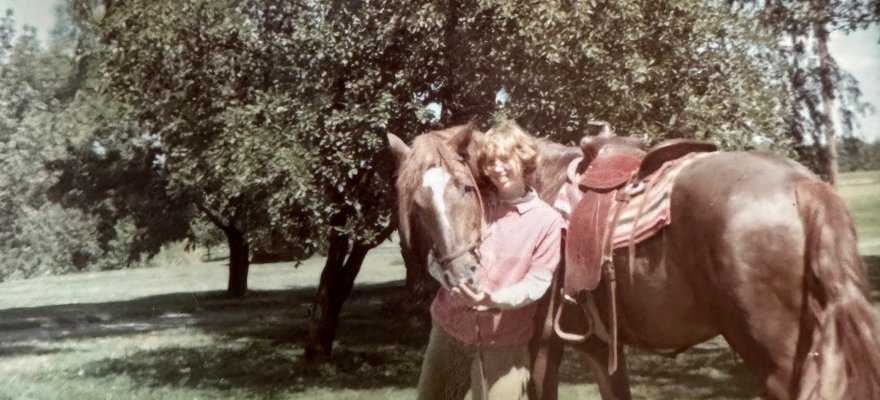
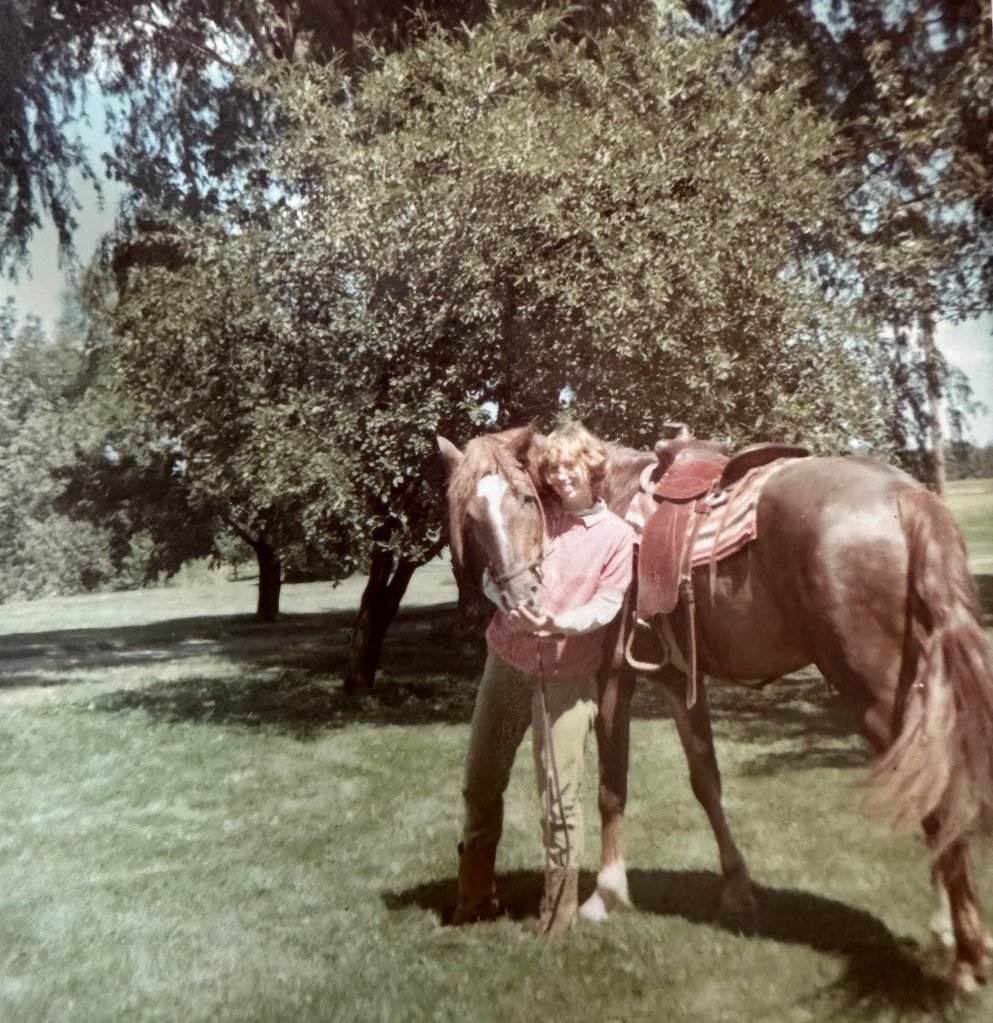
Here I am with my horse, Morgy, long long ago . . . in our front yard in South Amherst, Ohio.

To order Letters of the Karst, request it from your local library or order from amazon, here.

Chapter 4: Abandoned Quarry

In Letters from the Karst, every chapter/story features a cave of some sort. In chapter 4, it’s an abandoned quarry. Where I grew up in northern Ohio, abandoned quarries could be scary places. If they had filled with water there might be rusted old cars and trucks or big boulders just out of sight. They seemed like lonely places to me, possibly haunted by spirits of people who had died nearby. In “Abandoned Quarry” there’s also a play on “quarry,” as a thing that is hunted, a victim.

The story belongs to Patrick (who went hunting with Ned in “Early Blur”) and his daughter Phyllis. Phyllis is an adolescent with a cheerful demeanor who is also fiercely protective of her pet cat, Veronica. I can’t say much about this story without telling too much, but I can focus more on the land.

I don’t have any photos and couldn’t find one online that exactly matches my memory—or what my memory has done to the actual quarries around Amherst. My Ohio friends might want to see these from “Amherst Quarry Photographs.” Since I moved to Kentucky in 1996 and have been to eastern Kentucky many times, I’ve also witnessed other quarries or quarry-like holes in the land. Some of them look like what a human body would look like scraped across an asphalt parking lot. But no, the wounds are deeper. The scars from mountain top removal, for instance, look like a body that has also been carved and gouged out; the wounds are the remains of coal mining, oozing chemicals like arsenic and cadmium, which run through the veins of the communities polluting water and land alike. (One of the “caves” in a later story of Letters from the Karst is an abandoned mine, such as the one in Lynch, Kentucky.)

The “abandoned quarry” that’s located near where Patrick and Phyllis live is dead. But there are signs of life: at the bottom where scrub brush is taking off and along the walls where small trees find a root-hold and their branches reach toward the light.

Rather than show the damage we can do to the land, here’s a glimpse of the beauty of eastern Kentucky. It’s the kind of place that brings serenity, says peace.

To order Letters of the Karst, request it from your local library or order from amazon, here.

Chapter 3: Early Blur

There is a creative writing dictum that says, Thou Shalt Not Write about What Thou Knowest Not. But how can that be? It’s okay as a reminder not to reject your own experience as boring or of no interest to others. But if you follow it to its logical conclusion, you will find yourself floating on a very small raft in your bathtub. It’s probably always Monday night. But due to the power of empathy, writers over the centuries have written brilliantly about characters whose lives are nothing like their own.

So, this chapter was a challenge in that regard. It’s Ned’s story. He’s the uncle of the Collins sisters and Meredith’s brother. A contractor and a hunter, Ned is also a deeply private man. Since I am neither a contractor nor a hunter, I had to do a lot of research. Certain terms lingered in my brain like misplaced curios. I had to use “mast” in sentences, usually silently in my head, until it stopped sounding like a breast condition, missing the “itis.” There’s a thing called a “mast year,” described in Local Ecology this way:

How big is a bumper crop compared to non-mast years? Mike Hallworth, Vermont Atlas of Life, quantifies the difference between mast and non-mast years: “During mast years, there may be anywhere between a 3- to 9-fold increase in the amount of nuts and cones.”

I learned the term “early blur” from my youngest son’s best friend’s father, who kindly talked to me extensively about squirrel hunting. The term refers to the tendency of the human brain to think it sees what it expects to be there. This passage, from Outdoor Notebook, explains it well:

The hunter often toils in the world that psychological researchers refer to as ‘early blur.’ His is the first pale hour of dawn in the woods and the last blue-gray wash of gathering twilight. Even at midday, the sun-and-shadow dapple of the forest floor and broken shadows of the swamp can confuse vision.

Who among us hasn’t stalked a “deer” that turned out to be a strange-shaped stump or the silhouette of a bush against the sky? Tell me that you’ve never turned a rustling leaf into a buck’s ear, a horizontal patch of gray or brown into a flank, or a twisted maple branch into antlers.

Although this is Ned’s story, there are two other characters who feature here (and in other stories as well). There’s Will, Mary’s son, back from his stint as a roustabout in Alaska. And there’s Patrick, the single father of a girl name Phyllis, whose story takes place in Ohio, where they meet Ned and his son, Sonny. It’s Patrick who introduces the term “early blur” when he mistakes a raccoon for a squirrel. Because I’ve never spent time with men as a man, I had to make them a little bit like me. Will is brash and blunt, a little clueless. Patrick is an intellectual, not prone to joking around, reflective about what he’s doing. Ned, the loner, enjoys their company but his fantasy of going off grid, living alone in the forest, is what occupies his thoughts.

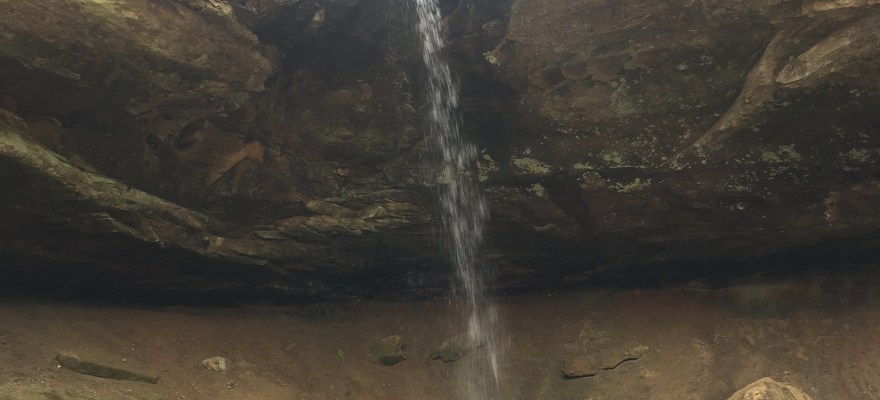
The cave where they spend the night is a rock house, very common in Kentucky. It’s basically an overhang, but deep enough to have been used at one time as a dwelling. In the picture below, you get the idea of the kind of rock house I had in mind, behind the waterfall of Shanty Hollow. There are other amazing rock houses along the trail, some of them deeply pock-marked by erosion. Ned’s rock house has no waterfall and its floor is level enough for them to sleep comfortably.

Patrick and Will tell something of their lives during their two days together—squirrel hunting, settling in over the campfire, hiking. What we learn of Ned comes through his thoughts; he’s a quiet man. I wanted their conversation to do more than reveal their personalities and to suggest the way acquaintances can bond and their connection deepen even when nothing much seems to change, on the surface—but underneath, in the subterranean world? As Will puts it, “‘Talking about personal shit is like walking across where a war was and you got to steer away from places where you’ll get blowed up.’”’ He looks up from where he’s been staring into the fire but Patrick’s right there with him. ‘Sometimes talking is the only way out of a place, like your voice is a map.’” This is where Ned steps in to say, “This strikes me as a good place to get on a different road, so I put on my turn signal.”

To order Letters of the Karst, request it from your local library or order from amazon, here.

Chapter 1: “Letters from the Karst”

This is the title story, told by the middle daughter, Cecily, along with a series of letter. This first chapter and the last one, “Extremophiles,” narrated by her mother, provide the bookends for the Collins family story. I won’t divulge anything that belongs to Cecily, so this will touch on other things.

Cecily has suffered from pretty severe substance abuse; the probable cause is divulged in her story. I have some experience with the intractability of addictive behavior, its seductions and high costs. My youngest son struggled throughout his teen years, spending most of his days in various institutions—special schools, incarcerations, treatment centers. Even when he was at home, he was on yard restriction and we went to weekly treatment and therapy sessions. When he was killed at age twenty, the autopsy declared his toxicology negative. His painful journey ended as he was making a turn-around, perhaps the one that would have set him on a better path. I am sure that Casey was in my thoughts when I wrote from Cecily’s perspective or about her in another chapter, which belongs to a former boyfriend, Derek (but more on him later). I tell Casey’s story along with my own and my family’s journey to healing in The Tree You Come Home To, which you can read about, under “Memoir.” (Here is a picture of Casey with his counselor Mr. Wright after he completed his time at Care Academy, about two hours from home, with his symbolic monkey around his neck.)

Cecily is the second of three girls born to Meredith and David. Her older sister, Diana, like so many oldest children, feels that she must bear the responsibility for her siblings’ well being. Because the younger sister, Molly, was born on the same day as Cecily, Cecily has always thought of Molly as belonging to her. In Letters from the Karst, this tight-knit group of siblings come to the fore and then recede as the other characters take their turns.

I think I was drawn to writing about siblings because I was an only child—at least I was raised as an only child, my three brothers and sister being raised by our father and their stepmother two states away. As a child I made friends with girls from big families (not coincidentally). One in particular, Barbara Dodson, shared the same birthday, which made us instant best friends. Her large family lived a block away and I remember being there whenever I could. I loved eating dinner with them at the end of a day of play. It was always hotdogs or canned spaghetti and I thought their meals were divine. I remember her uncle peering into the bottom of the TV screen to try to see into the cleavage of some actress. Male humor was completely foreign to me, living as I did with my mom, just the two of us. So writing Diana, Cecily, and Molly into being seemed to bring someone I already knew to life.

To order Letters of the Karst, request it from your local library or order from amazon, here.