Each chapter (or story) in Letters from the Karst features a different kind of cave or big hole in the ground. Like a karst system in which some caves are intimately connected and others less so, the characters may have close ties or be more removed, as is the case with Pat Likens in “On the Beautiful O-hi-o.” That phrase was rattling around in my mind at the time of writing this story, and since I grew up in Ohio, I like it that the setting, though in Kentucky, is partly on the banks of the Ohio—there I am marked and shaped by both Ohio and Kentucky.
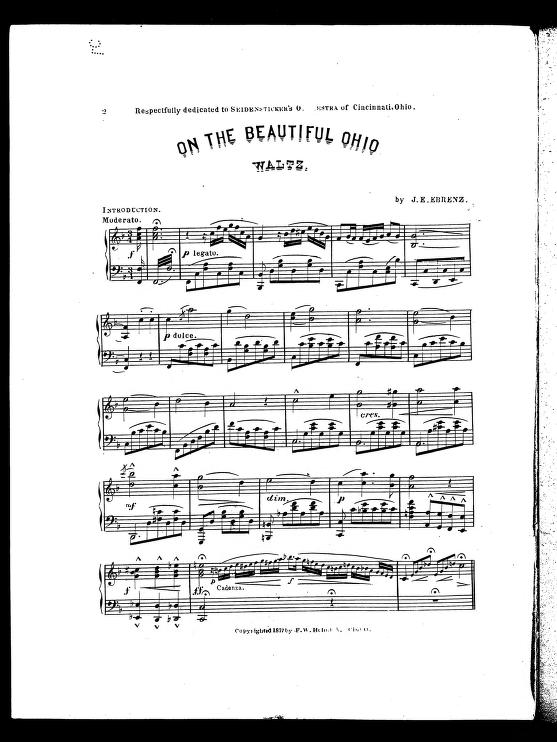
Here is an image of the sheet music for the waltz of the same name, in public domain. (My mom would approve of my including an image of written music.)
Pat is a colleague of Meredith at WKU, teaching in the English department. The first word is “Married,” and Pat is not happily so. The full sentence reads, “Married, Pat Likens lay in bed after her husband fell asleep, imagining his death.” It’s not an abusive relationship but Carl is possessive, and Pat is ready to move on. More than any other chapter, “Oh the Beautiful O-hi-o” weaves Pat’s dreams into the narrative that ends at a party of a colleague who has a big house on the Ohio River.
In an allusion to Virginia Woolf’s metaphor in A Room of One’s Own, the opening dream is of her fishing “where consciousness floated on top like an anchored dock at the edge of a country pond.” The dream intensifies:
Her shoulders strained and her feet slid in the muddy grass toward the pond. The pole bent dangerously, and suddenly the line angled beneath the bank, as though she were on a boat and the fish about to surface behind her. She even turned, and yes there were the trees, her car parked at the top of the small hill, the lawn chair with her book unopened in the grass beside it. She turned back and caught her first glimpse of something below the surface, and then her pole snapped. A moment later a man’s arm grabbed hold of a root just inches from her foot and began to pull a body tangled in fish line out of the water.
Pat’s dreams are violent, but there is no violence in waking time. All rage and disappointment have been sublimated and appear in dreams. The cave in this story appears in the final dream as a place that’s eerie and suggestive of danger. But everything happens outside the cave:
Ahead she saw the darkened entrance to the cave and behind her she felt the dogs’ breath on her heels. Time paused as she slid into a weird space and an ethereal sound arose from the depth of the cave before her; she stretched her arms toward it and with a snap, her dream picked up where it had left.
Dreams are important cave-like phenomena, emerging from the deep and bringing the darkness to the surface. But darkness is not necessarily bad, despite our fear of it; in fact, it’s essential to the processes that allow us to change our world.
You can order Letters from the Karst from your local library or from Amazon, here.
 Jane Olmsted