There is a creative writing dictum that says, Thou Shalt Not Write about What Thou Knowest Not. But how can that be? It’s okay as a reminder not to reject your own experience as boring or of no interest to others. But if you follow it to its logical conclusion, you will find yourself floating on a very small raft in your bathtub. It’s probably always Monday night. But due to the power of empathy, writers over the centuries have written brilliantly about characters whose lives are nothing like their own.
So, this chapter was a challenge in that regard. It’s Ned’s story. He’s the uncle of the Collins sisters and Meredith’s brother. A contractor and a hunter, Ned is also a deeply private man. Since I am neither a contractor nor a hunter, I had to do a lot of research. Certain terms lingered in my brain like misplaced curios. I had to use “mast” in sentences, usually silently in my head, until it stopped sounding like a breast condition, missing the “itis.” There’s a thing called a “mast year,” described in Local Ecology this way:
How big is a bumper crop compared to non-mast years? Mike Hallworth, Vermont Atlas of Life, quantifies the difference between mast and non-mast years: “During mast years, there may be anywhere between a 3- to 9-fold increase in the amount of nuts and cones.”
I learned the term “early blur” from my youngest son’s best friend’s father, who kindly talked to me extensively about squirrel hunting. The term refers to the tendency of the human brain to think it sees what it expects to be there. This passage, from Outdoor Notebook, explains it well:
The hunter often toils in the world that psychological researchers refer to as ‘early blur.’ His is the first pale hour of dawn in the woods and the last blue-gray wash of gathering twilight. Even at midday, the sun-and-shadow dapple of the forest floor and broken shadows of the swamp can confuse vision.
Who among us hasn’t stalked a “deer” that turned out to be a strange-shaped stump or the silhouette of a bush against the sky? Tell me that you’ve never turned a rustling leaf into a buck’s ear, a horizontal patch of gray or brown into a flank, or a twisted maple branch into antlers.
Although this is Ned’s story, there are two other characters who feature here (and in other stories as well). There’s Will, Mary’s son, back from his stint as a roustabout in Alaska. And there’s Patrick, the single father of a girl name Phyllis, whose story takes place in Ohio, where they meet Ned and his son, Sonny. It’s Patrick who introduces the term “early blur” when he mistakes a raccoon for a squirrel. Because I’ve never spent time with men as a man, I had to make them a little bit like me. Will is brash and blunt, a little clueless. Patrick is an intellectual, not prone to joking around, reflective about what he’s doing. Ned, the loner, enjoys their company but his fantasy of going off grid, living alone in the forest, is what occupies his thoughts.
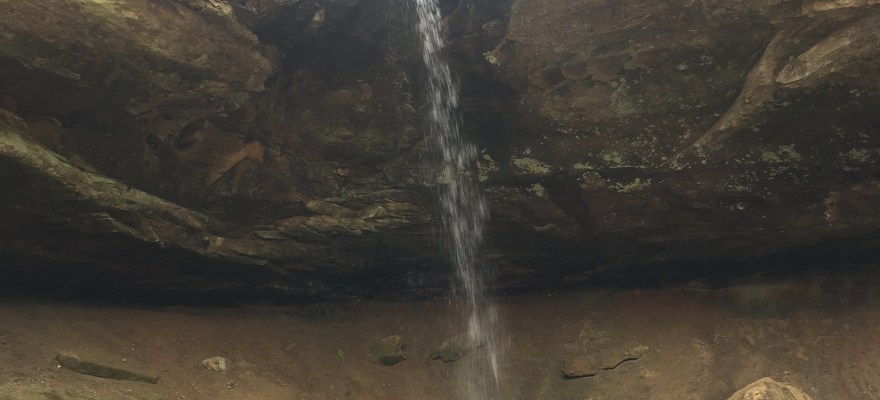
The cave where they spend the night is a rock house, very common in Kentucky. It’s basically an overhang, but deep enough to have been used at one time as a dwelling. In the picture below, you get the idea of the kind of rock house I had in mind, behind the waterfall of Shanty Hollow. There are other amazing rock houses along the trail, some of them deeply pock-marked by erosion. Ned’s rock house has no waterfall and its floor is level enough for them to sleep comfortably.

Patrick and Will tell something of their lives during their two days together—squirrel hunting, settling in over the campfire, hiking. What we learn of Ned comes through his thoughts; he’s a quiet man. I wanted their conversation to do more than reveal their personalities and to suggest the way acquaintances can bond and their connection deepen even when nothing much seems to change, on the surface—but underneath, in the subterranean world? As Will puts it, “‘Talking about personal shit is like walking across where a war was and you got to steer away from places where you’ll get blowed up.’”’ He looks up from where he’s been staring into the fire but Patrick’s right there with him. ‘Sometimes talking is the only way out of a place, like your voice is a map.’” This is where Ned steps in to say, “This strikes me as a good place to get on a different road, so I put on my turn signal.”
To order Letters of the Karst, request it from your local library or order from amazon, here.
 Jane Olmsted